Rural and Agricultural Policy Suite - Make Australia Beautiful Again
New Bradfield Scheme and National Irrigation Policy
The Bradfield Scheme was proposed in 1938 as an envisioned inland irrigation project in order to drought-proof the western Queensland interior and parts of South Australia. However, it has been consistently debated whether the original scheme is economically viable or even practical. But no one can deny the need for such projects in order to drought-proof in arid lands of inland Australia.
The Eureka Party supports an inquiry and research and development into how the Bradfield Scheme may be modified into a new scheme that is more practical and viable, to help deliver real food security to Australians.
The Eureka Party supports an inquiry and research and development into a viable equivalent to the Bradfield Scheme in Western Australia to create more fertile land in the west of the country.
The Eureka Party supports other minor irrigation projects necessary to open up more land for the National Permaculture Transition (see below).
Abolition of Factory Farming
Factory farming has for a long time been a moral stain on humanity, and has also contributed to the consolidation of unfair competitive advantage by the meat industry at the expense of small farmers.
The Eureka Party supports the phased abolition of factory farming, nationwide, and a return to the normalcy of animal husbandry that benefits the small farmer and contributes to making our nation look beautiful again.
Land Reform
The Eureka Party supports the socialisation of big agribusiness at 110% of market cap, to bring control of Australia’s food supply into public hands.
The Eureka Party supports the redistribution of suitable agricultural land to small farmers and graziers in the vicinity as freehold title, free of charge to farmers.
Incentives for the Formation of Agricultural Cooperatives
As part of his agrarian socialist tradition, Bob Katter has consistently lamented the loss of farmer-owned cooperatives in dairy and sugar industries that once had Queensland’s sugar mills almost entirely owned by the growers themselves rather than foreign corporations, a state of affairs left out of dry as a result of neoliberal deregulation.
The Eureka Party supports legislating incentives for small farmers across Australia to come together and form agricultural cooperatives in farming, dairy, sugar and other industries, including tax and other financial incentives, grants, training, and government procurement preferences.
National Permaculture Transition
Early colonial accounts described Australia’s landmass as beautiful, resembling a well-managed estate that had been the result of cultivation and management by Aboriginal Australians for tens of thousands of years before European arrival. Centuries of extractive industrial agriculture and chemical-dependent monoculture have left the land scarred and dying.
Permaculture as a philosophy was invented here in Australia by Bill Mollison and David Holmgren, as a modern form of regenerative agriculture based on precolonial Aboriginal land management techniques rooted in millennia of native culture. It offers our farmers and broader society the path to restoring the land of this great nation and achieving lasting, resilient food security while reducing or even eliminating the need for harmful chemicals or imported fertilisers.
The Eureka Party supports the initiation of an effort to facilitate a state-funded national transition to permaculture led by communities, traditional owners and the Public Works Army, including:
the conversion of all unused or underutilised public land, including national and public parks, into a nationwide food commons;
the conversion of all pastoral land into permaculture silvopasture land, at no cost to graziers;
incentives for the progressive conversion of Australia’s entire agricultural sector to permaculture, at no cost to farmers;
incentives for the progressive transformation of household yards in suburban, regional, rural and remote areas across Australia, at no cost to families and homeowners, and with consideration given to their needs;
This national permaculture transition will transform hundreds of millions of hectares, create millions of jobs over decades, revive Australia’s ecology and climate, bolster our terrestrial carbon sink, reduce the frequency and severity of natural disasters, including floods and droughts, and create an Edenic ecological paradise in the Australian interior. It’s time to Make Australia Beautiful Again!
Socialise the Supermarket Duopoly
For far too long, Coles and Woolworths, controlling approximately 70% of Australia’s retail grocery market, have been a parasite on both producers and consumers of food, undercutting small farmers and price gouging consumers for the most basic of needs, all while paying their workers some of the lowest rates in the country. Enough is enough.
The Eureka Party supports the socialisation of the Coles-Woolworths duopoly at a baseline of 110% of market cap, to bring control of the logistics and distribution of the most essential needs under public control, liberate supermarket workers, some of the lowest paid workers in Australia, pay farmers a fair price for their hard-grown produce, and lower checkout prices for Australian families.
Rural Revival
For too long, rural and remote towns across Australia, especially in Queensland, have been drained of population, jobs and opportunity by coastal-centric governments. Inland mining and farming communities face chronic housing shortages and overcrowding while young families are forced to the cities.
The Eureka Party supports a bold, state-funded and community-led rural revival, to transform declining inland rural and mining towns into thriving, self-reliant cities and grow remote communities into viable, sustainable towns, along with establishing new ‘permaculture settlements’ within public permaculture gardens built using earthen construction methods, delivering the affordable housing and infrastructure every Australian is entitled to.
New housing, constructions and infrastructure will be designed with community input to favour local heritage architectural styles over urban brutalist styles, and incentives for young workers and families to relocate inland will ease urban pressure, rebuild regional economies, and finally deliver the Working Man’s Paradise in the heart of Australia.
Pamphlet Coming Soon
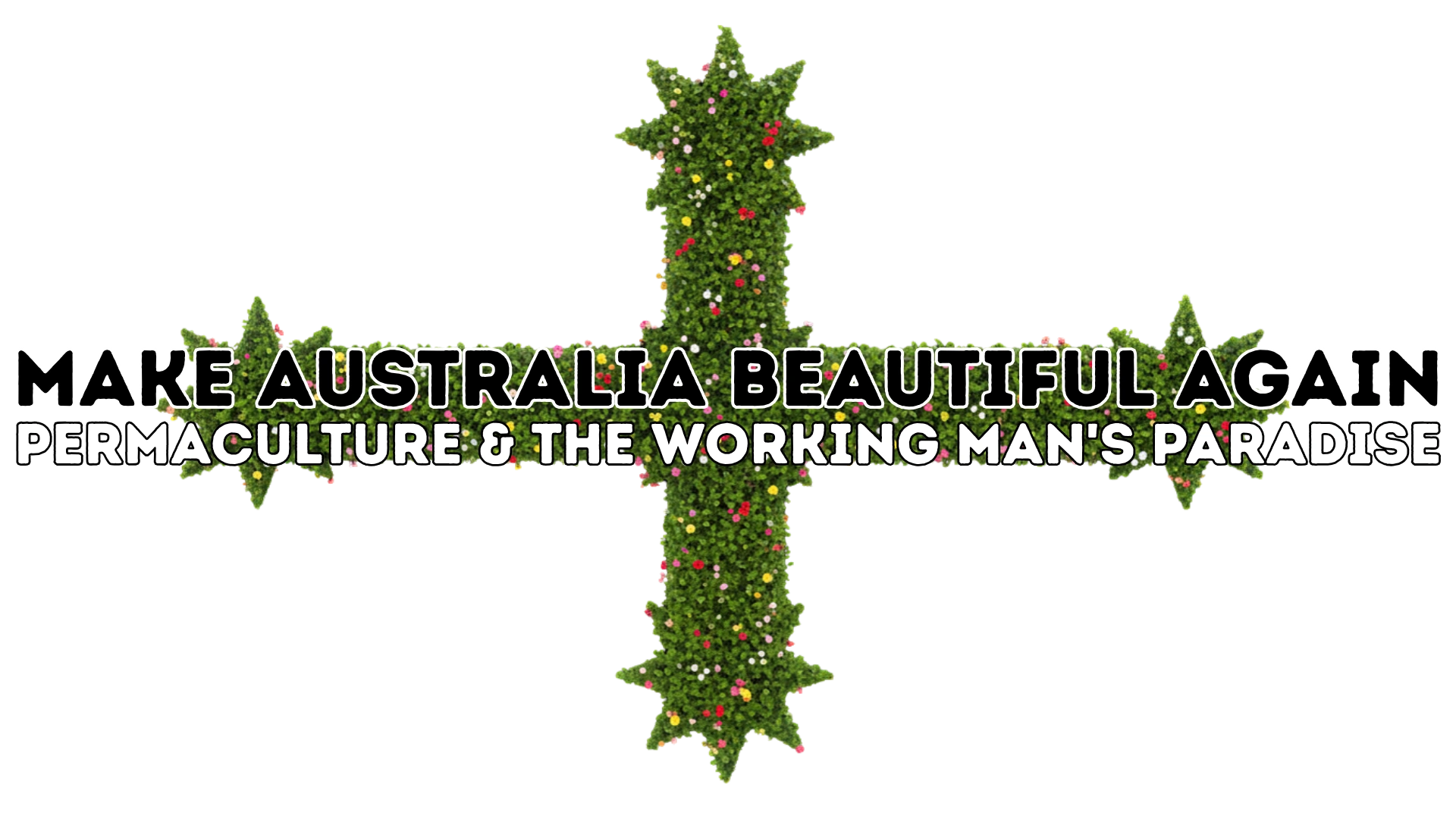
The third Eureka Paper expanding on this section of the Eureka Party's program, Make Australia Beautiful Again: Permaculture & the Working Man's Paradise, is scheduled for release in mid 2027. Stay tuned.
Frequently Asked Questions
No. Small family farms are explicitly protected from acquisition. Only foreign-owned and large corporate agribusiness holdings are acquired, with full compensation at a minimum of 110% of market value. Acquired land follows a dual-track model: viable family-scale holdings are redistributed to local small farmers as freehold title at no cost, and large-scale operations that can't be subdivided are socialised under democratic workers' councils. Nobody who currently works the land loses their livelihood - small farmers gain land, and station workers gain democratic control.
The Great Leap Forward failed because it disrupted existing food production through coercion and pseudo-science. Our policy avoids this entirely through phased implementation: we begin with unused public land, household yards, and silvopasture integration that doesn't interrupt existing grazing. Commercial agriculture transforms only after new systems prove their yield. No farmer is forced to participate. This is evidence-based ecological engineering, not ideological experimentation.
No. Small family farms are explicitly exempt from acquisition. We're targeting the approximately 13% of agricultural land owned by foreign investors (roughly 50 million hectares) and large corporate agribusiness holdings. If you run a family operation, you keep your land and gain access to cooperative incentives and permaculture transition support.
Soviet supermarkets were empty because they were run by top-down bureaucracy with no worker input or market signals. Our model replaces corporate management with democratic workers' councils integrated into the Public Works Army. Workers who actually run the stores manage them. Prices are set at cost-plus-reinvestment, not profit maximisation - which means lower prices and higher volume, not shortages. The difference is democracy versus bureaucracy.
Permaculture was invented in Australia by Bill Mollison and David Holmgren, based on 60,000 years of Indigenous land management. It's not environmentalist restriction - it's agricultural engineering that reduces input costs (fertiliser, pesticides), improves drought resilience, and produces healthier, better-tasting food. The Public Works Army provides the labour for transition at no cost to farmers. This is about making farms more profitable and more resilient, not telling farmers how to farm.